
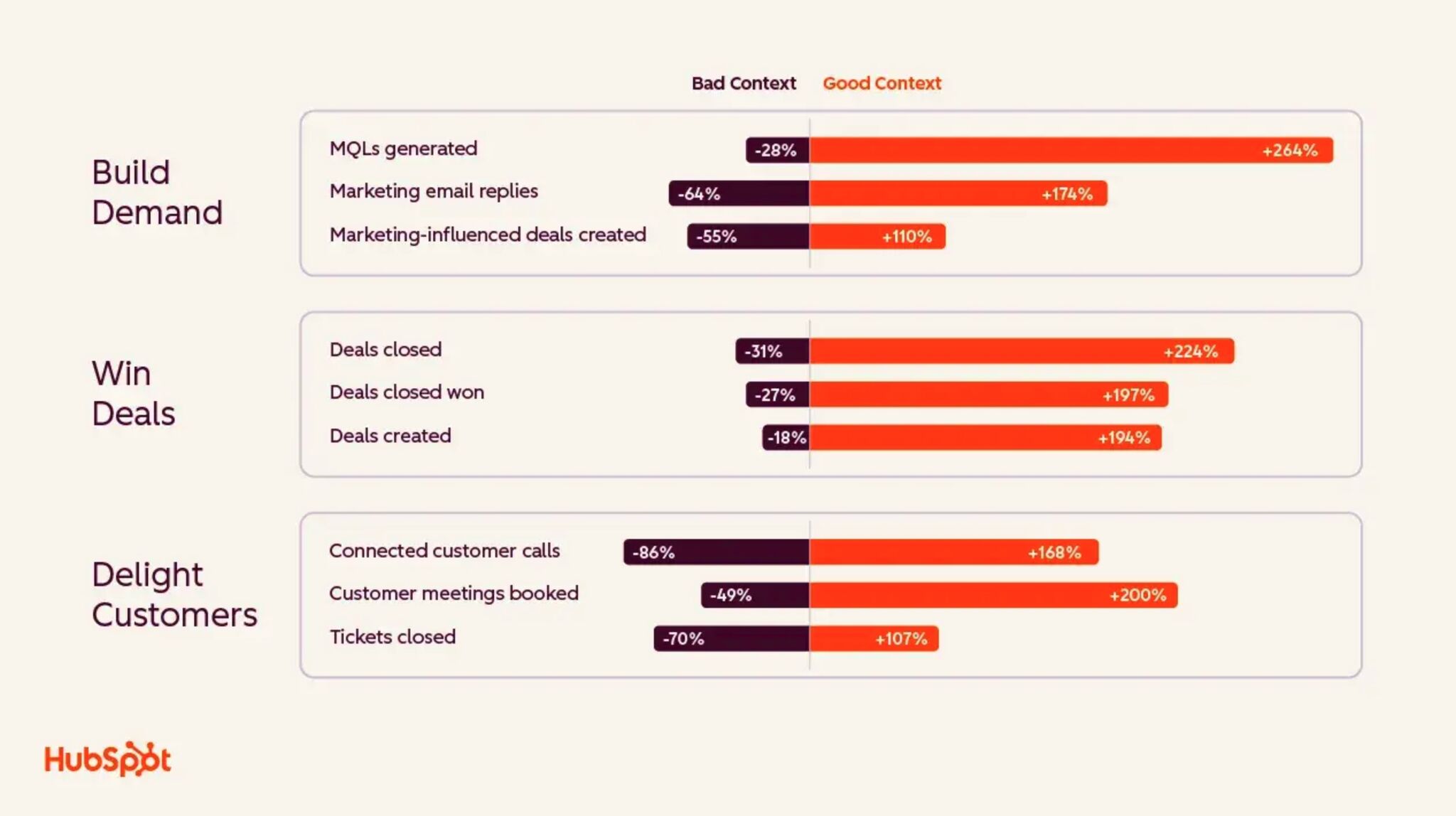
I spend a lot of time talking about what’s new in HubSpot: new features, new functionality, new ways to automate processes, and new tools that make the platform more powerful. So it surprised me a little that one of my biggest takeaways from HubSpot’s Unbound event wasn’t a product announcement at all. It was a single slide about context.
(Source: HubSpot)
HubSpot shared data from more than 300,000 companies comparing the impact of AI when it had good context versus bad context. With good context, MQLs generated increased 264%, deals closed won increased 197%, and customer meetings booked increased 200%. With bad context, those same metrics moved in the opposite direction: MQLs decreased 28%, deals closed won decreased 27%, and customer meetings booked decreased 49%.
Those numbers reinforced something that is increasingly important as AI becomes embedded in the way we work: your AI strategy is only going to be as good as the context you give it.
And even if you aren't using AI extensively today, the context you're creating today matters.
Your CRM is the context layer for AI
For years, we’ve talked about CRM hygiene primarily in the context of operational efficiency and reporting. We need clean data so our dashboards are accurate. We need salespeople to log activity so managers can see what’s happening. We need consistent lifecycle stages so marketing and sales can agree on the funnel. We need reliable deal stages so the forecast means something.
All of those things still matter, but AI raises the stakes.
As AI becomes more deeply embedded in marketing, sales, customer success, and service, the CRM isn't simply storing information for humans to reference later. It is increasingly providing the context AI uses to understand the business, interpret what is happening with a prospect or customer, recommend what should happen next, and eventually take action.
That makes incomplete data more consequential.
If a salesperson has three important conversations with a prospect but none of them are recorded, AI doesn't know those conversations happened. If customer success knows that an account is unhappy but that information exists only in someone's head or a Slack conversation, it isn't part of the customer record. If a customer churns but nobody records why, you've captured the outcome without capturing the context behind it.
This is why one of my favorite CRM principles has become even more relevant:
If it doesn't happen in the CRM, it didn't happen.
Obviously, it happened. But if the information isn't accessible to the rest of the organization — and increasingly, to the AI systems operating on that information — its usefulness is extremely limited.
AI readiness starts with cleaning up what you already have
When companies start thinking about AI, the natural inclination is to focus on what they should add: another tool, another integration, another agent, another workflow, another source of data.
I would start by looking at what is already there.
A CRM that has been in place for several years almost always carries some baggage. Processes change. Teams change. Systems are migrated. Properties are created for one campaign and never used again. Imports introduce duplicates. Integrations create records differently than expected. Someone creates a second property because they don't realize the first one exists. Five years later, nobody knows which field is supposed to be authoritative.
Before adding more context, make sure the context you already have is worth using.
1. Cull the bad data
The goal isn't to have as much data as possible. The goal is to have data you can trust.
That means establishing criteria for records that should be cleaned, merged, archived, excluded, or deleted rather than simply allowing the CRM to accumulate indefinitely. Depending on your database, that review might include:
- Duplicate contacts and companies.
- Spam, solicitation, test, and internal records.
- Contacts with invalid or chronically bouncing email addresses.
- Companies without meaningful identifying information, associations, or activity.
- Records created by old integrations or imports that no longer serve a business purpose.
- Contacts and companies that have been inactive for years and have no meaningful historical value.
- Records with incomplete or contradictory information that need remediation rather than deletion.
This doesn't mean "delete every record that hasn't engaged in 12 months." Historical information can provide extremely valuable context, particularly when you're trying to understand long sales cycles, previous opportunities, customer relationships, churn, or re-engagement.
The question should be: Does this record contribute useful context, or is it simply adding noise?
2. Clean up your property architecture
Bad records are only one part of data hygiene. The structure underneath those records matters just as much.
Most mature HubSpot portals accumulate what I think of as property debt. There are duplicate properties, abandoned properties, migration fields, one-off campaign fields, fields created for integrations that no longer exist, and properties with names so vague that nobody remembers what they were intended to capture.
This becomes particularly problematic when multiple properties appear to represent the same concept. If you have "Customer Type," "Account Type," "Company Classification," and "Client Category," which one represents the truth?
A property audit should look beyond whether a field happens to contain data. For each meaningful property, determine:
- Purpose: What business question does this property answer?
- Owner: Which team or process is responsible for maintaining it?
- Source: Is it entered manually, populated by automation, synced from another system, or calculated?
- Authority: If the same information exists elsewhere, which field or system is the source of truth?
- Usage: Is it actively used in segmentation, automation, reporting, personalization, qualification, or another operational process?
- Relevance: Does it still reflect how the business operates today?
If nobody can explain why a property exists or what should populate it, that's a pretty good sign it shouldn't be part of the context you're asking AI to interpret.
Don't confuse more data with better context
Once you start talking about AI and context, it is easy to reach the conclusion that you should capture absolutely everything as structured data.
I don't think that's the answer either.
Not every answer needs a property. Not every piece of information needs to be a dropdown. Not every sentence from a discovery call needs to become a field on the contact or company record.
Good CRM architecture distinguishes between structured data and unstructured data, because both have value for different reasons.
Structured data gives you consistent signals you can filter, automate, segment, score, and report against. That might include lifecycle stage, lead status, industry, company size, customer type, product interest, deal stage, renewal date, churn reason, or qualification criteria.
Unstructured data provides the nuance around those signals: emails, meeting notes, call transcripts, support conversations, survey responses, customer feedback, and other communications.
You need both.
A structured property may tell you that a deal was lost because of budget. The associated emails and call transcripts may reveal that the customer actually liked the solution, couldn't secure budget this fiscal year, and asked the salesperson to reconnect in January. "Lost — Budget" alone doesn't tell that story.
The goal should not be to turn every interaction into 50 fields. It should be to make sure the CRM contains enough structured information to understand what happened, while retaining enough unstructured information to understand why it happened.
"If it doesn't happen in the CRM, it didn't happen" has to become a team habit
Data cleanup will only get you so far. You can spend three months cleaning a portal and be right back where you started six months later if the organization doesn't change how it uses the CRM.
This is where AI readiness becomes less of a technology problem and more of an operational one.
Marketing needs to record meaningful engagement and campaign context. Business development needs to capture qualification and outreach. Sales needs to maintain opportunities and record customer conversations. Customer success needs to capture onboarding, adoption, risk, expansion, and renewal activity. Service needs to document issues and resolutions.
That doesn't mean every team needs to manually enter everything. In fact, they shouldn't.
The objective should be to create systems where important context makes its way into the CRM with as little unnecessary administrative burden as possible. That may mean:
- Connecting individual work email accounts and calendars so correspondence and meetings can be captured appropriately.
- Using meeting recording and transcription so the substance of conversations doesn't disappear into someone's handwritten notes.
- Integrating customer-facing systems when meaningful interactions happen outside of HubSpot.
- Automating properties when the value can be reliably determined from other information.
- Using required fields strategically at specific points in a process rather than making everything required all the time.
- Standardizing loss reasons, churn reasons, qualification criteria, customer classifications, and other information that needs to be consistently analyzed.
- Creating clear expectations around what belongs in the CRM versus what can remain in another operational system.
The goal isn't more data entry. The goal is better context.
If it takes a salesperson ten minutes of manual administration after every meeting to keep the CRM current, that's an architecture problem as much as it is an adoption problem.
Your CRM should reflect the entire customer lifecycle
One of the biggest gaps I see in CRM strategy is that companies tend to capture a tremendous amount of information about how someone becomes a customer and considerably less about what happens afterward.
Think about how much information we typically collect before Closed Won: original source, campaign engagement, form submissions, qualification criteria, discovery notes, stakeholders, deal stage, amount, products, close date, competitors, and loss reasons.
Then someone becomes a customer, and the data can become surprisingly thin.
If we're building the context AI will eventually use to understand our business, we need to know more than who buys. We need to understand what happens to them after they buy.
That includes questions such as:
- What did they purchase, and why?
- What did the onboarding or implementation experience look like?
- How quickly did they adopt the product or service?
- What support issues did they encounter?
- What feedback did they provide?
- Did the relationship expand?
- Did they renew?
- Did they churn?
- Why did they churn?
- Were they ultimately a successful customer?
This becomes incredibly important when we start asking AI more sophisticated questions.
Show me prospects that look like our best customers.
Which accounts may be at risk?
Which customers have expansion potential?
Which behaviors tend to precede churn?
Which marketing sources generate customers who actually stay?
What happened in this account over the last three years?
You can't answer those questions particularly well if your CRM has a detailed record of everything that happened before the sale and almost nothing afterward.
This is where a connected platform becomes incredibly powerful
This is one of the reasons I continue to believe in the value of a platform like HubSpot rather than thinking about marketing, sales, and service as completely separate technology decisions.
Marketing has part of the context. Business development has another part. Sales has another. Customer success, service, operations, and potentially product have their own pieces.
Your customer doesn't experience those as five different relationships.
They experience one relationship with your organization.
When those teams operate within the same platform — or when the systems they do use are thoughtfully integrated with it — the CRM can begin to reflect that complete relationship. AI can potentially see that a prospect attended an event, downloaded content, had three sales conversations, became a customer, struggled during onboarding, opened two support tickets, gave negative feedback, later expanded, and ultimately renewed.
That's very different context from a record that simply says:
Lifecycle Stage: Customer.
Documentation is part of your data strategy, too
There is another layer of context that I think is easy to overlook: your documentation.
AI doesn't only need to understand your contacts, companies, deals, and activities. As organizations start using AI to answer questions and execute processes, it also needs accurate information about how the business operates.
That means outdated documentation can become its own form of bad data.
If you have three versions of your lead qualification criteria sitting in different folders, an old sales process nobody follows anymore, outdated product documentation, obsolete SOPs, and conflicting definitions of what constitutes a qualified lead, you're creating the same problem you have with duplicate CRM properties: multiple potential versions of the truth.
Part of AI readiness should therefore include cleaning up the knowledge surrounding the CRM as well:
- Archive outdated process documentation.
- Establish authoritative versions of important SOPs.
- Document lifecycle stage and pipeline definitions.
- Document required fields and how they should be used.
- Maintain current qualification criteria.
- Keep product, service, pricing, and policy documentation current.
- Establish ownership for keeping critical documentation accurate.
We have spent years talking about a "single source of truth" in CRM strategy. AI makes that concept much bigger than a database.
Don't wait until you're ready for AI
The biggest mistake may be treating all of this as something you'll address when your organization is ready to "do AI."
By then, you're already behind.
The data you're collecting today becomes historical context tomorrow. The churn reason you capture today may become part of a future model for identifying customer risk. The discovery call you record today may eventually help AI recognize patterns among your highest-value customers. The lifecycle architecture you establish today determines whether future systems can accurately understand how people progress through your business.
And the reverse is also true.
Every important conversation that remains trapped in someone's inbox, every customer issue that never makes it into the CRM, every undocumented churn, every duplicate property, and every spreadsheet that becomes an unofficial second CRM creates a gap in that context.
You don't need to know exactly what AI will be capable of two years from now to know that giving it accurate, complete, well-structured information will put you in a better position to use it.
The less flashy side of AI readiness
There will always be a new AI feature to talk about. There will be agents to build, workflows to automate, models to test, and new capabilities that make for much more exciting demos than cleaning up CRM properties.
But I came away from Unbound thinking that some of the most important AI work companies can do right now isn't particularly flashy.
Cull the bad data.
Retire the properties nobody uses anymore.
Fix the processes that create inconsistent data.
Build a data model that reflects how your business actually operates today.
Capture what happens after Closed Won, including renewals and churn.
Bring structured and unstructured customer context together.
Clean up outdated documentation and establish authoritative sources of truth.
Make it easy for your teams to capture meaningful interactions in the CRM.
And make sure your CRM reflects what is actually happening across the entire customer lifecycle.
The better the models get, the more valuable that foundation becomes.
AI doesn't make CRM hygiene less important. It makes it exponentially more important.